RE-PEAT 5 YEAR STRATEGY
Look at the file to access the full version
The world we live in…
We are living through a period of profound ecological, social, and political upheaval. Climate breakdown, biodiversity loss, growing inequality, and democratic erosion are not separate crises, but interconnected outcomes of an economic system built on endless growth, extraction, and acceleration. This system requires ever more inputs to survive, whether of land, labour, or attention.
A central condition for this has been the disconnection of people from land and non-human creatures. Once land is reduced to a resource or commodity, damage to it no longer feels like damage to us. We have become producers and consumers rather than living beings embedded in ecological relationships of reciprocity and care.
While confronting powerful institutions and extractive systems is essential, we believe political work must also include restorative practices that reconnect people to land and place. Because once systems topple, what comes into place instead? What ideas and practices will be around in our communities to rise to the occasion?
This accumulation of crises creates a state of overwhelm that can often be paralysing rather than mobilising. Under rising workloads, increasing costs of living, constant exposure to global suffering, and looming climate futures, the toll on the human psyche is immense. The central question becomes how we stay with the trouble. How can we remain connected, hopeful, and capable of collective resistance in the face of it all?
The power of peatlands…
Peatlands cover just 3% of Earth’s land but hold 30% of its terrestrial carbon. While intact peatlands protect the climate, degraded ones drive 5% of global annual CO2 emissions making their restoration essential to the Paris Agreement.
Yet peatlands are more than carbon sinks they are deeply cultural landscapes that resist capitalist productivity, standardisation, and control. In a space dominated by technical solutions, artistic and cultural approaches offer vital, bottom-up pathways to ecological engagement bridging the gap between policy and community.
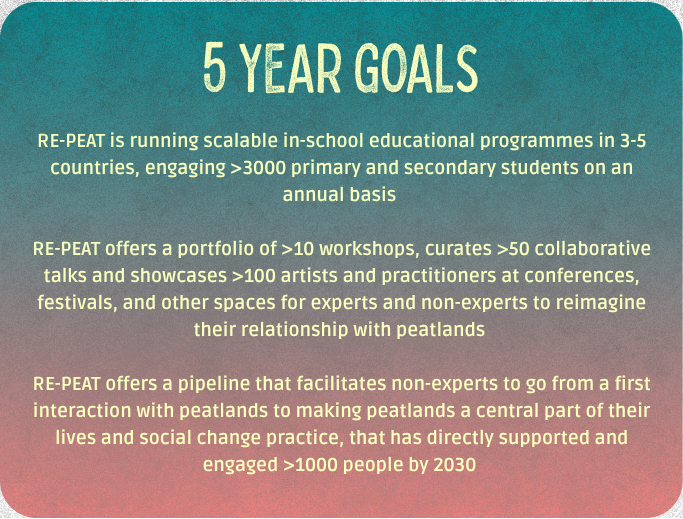
Our five-year strategy leverages peatlands as sites of cultural renewal and political education to build regenerative civic action rooted in connection and care.
Our Strategy
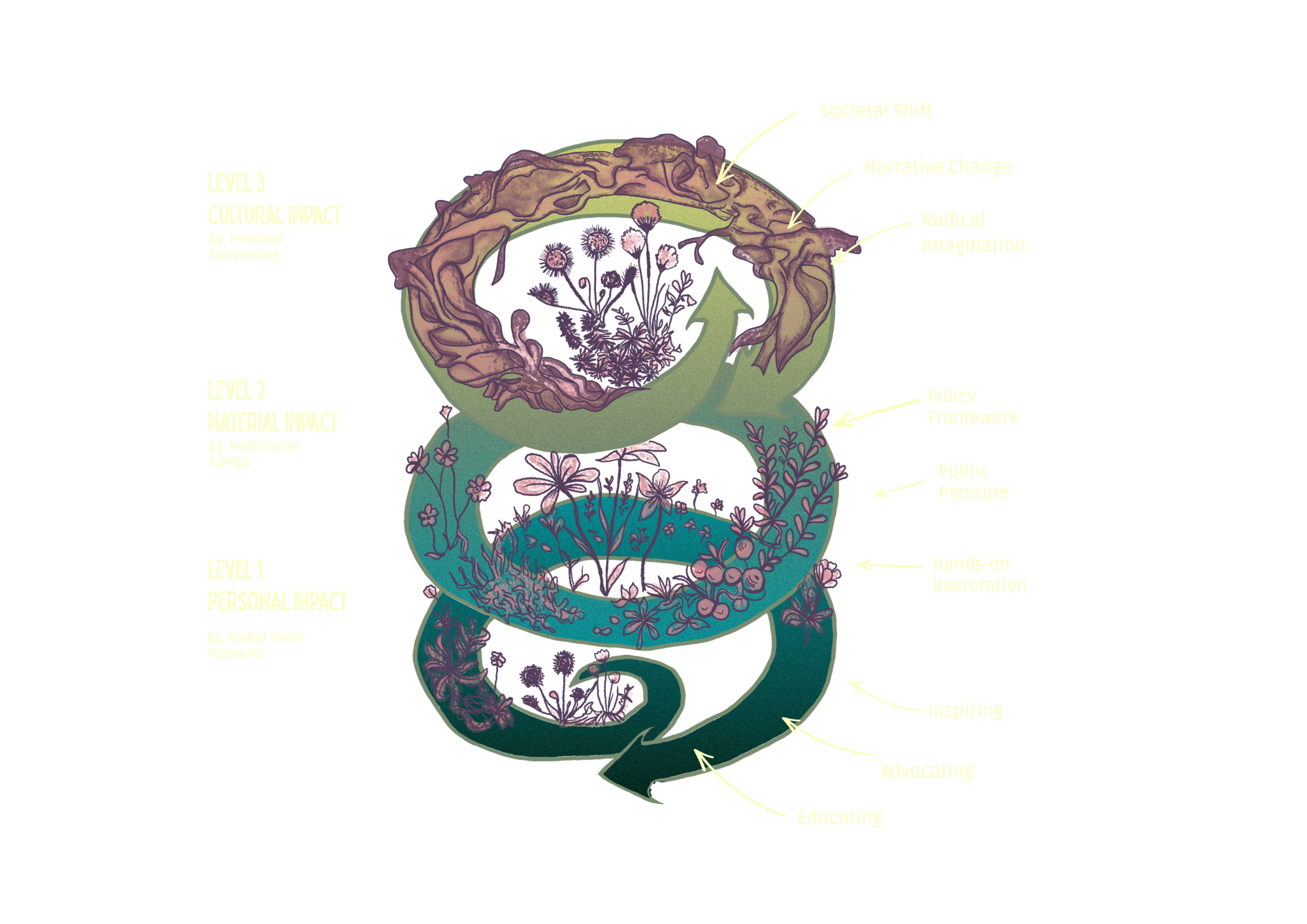
Addressing the multi-scale crisis of peatland degradation requires an integrated, multi-level response. Our five-year strategy employs three interconnected levers for change. By driving simultaneous progress across all three scales, each level reinforces the others to create long-term impact, supported by annual plans with measurable objectives.
The personal: transformative peatland journeys
RE-PEAT catalyses life-changing peatland journeys across generations through individual and collective education as well as immersive, multi-sensory peatland experiences. We create experiences where participants engage with peatlands as a medium for empowerment and inspiration to act for peatlands, and peatlands as a lens for understanding the complex systems that underpin the issues we are currently facing in society.
Rather than prescribing a single path, we support people to discover their own meaningful role in shaping a more just and peat-positive future. Our projects are geared towards those who have a curiosity about peatlands and are looking for ways to make a meaningful contribution to the world in these troubling times. As such, we are expanding the peatland workforce, building a group of people who carve out a livelihood in peatlands for themselves and others.
Projects: Bog Academy, Restoration Academy, Peat in Practice, Peat- Fest, Peat Pen Pals
The peatland: grassroots and community-led interventions
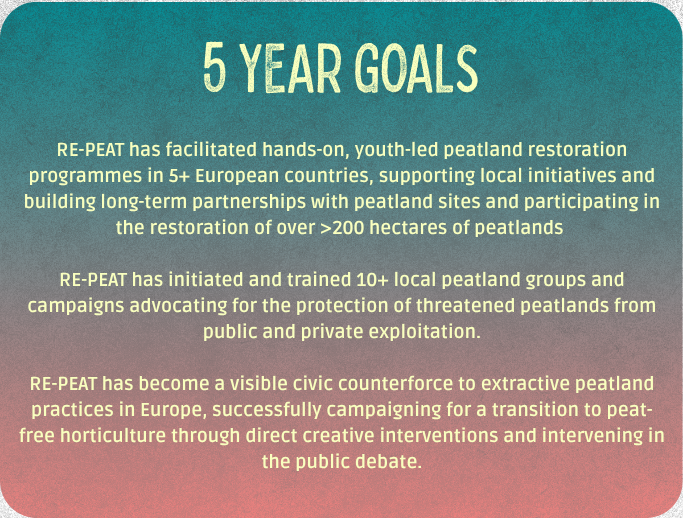
We intervene at multiple scales: from local paludiculture projects and land-use conflicts to international supply chains and policy frameworks. We initiate and support campaigns and public interventions that challenge destructive practices, strengthen civic resistance, and hold institutions and corporations accountable. In parallel, we contribute directly to peatland restoration through hands-on engagement and support for long-term community stewardship. As an international collective, we see ourselves as a critical trans-local connector, bridging these struggles around the globe and facilitating peer-to-peer exchange.
We approach peatland protection and restoration as social and political struggles. Our interventions are therefore transformative: guided by anti-capitalist orientation, solidarity across struggles, and community-led solutions. We work alongside affected communities and young organisers to build collective power, strengthen decentralised organising, and create lasting, material impact for peatlands.
Projects: Restoration Academy, Peat in Practice, Albert Heijn Turfvrij, Paludi Dinners, the Venice Agreement
The world: cultivating post-extractive imaginaries
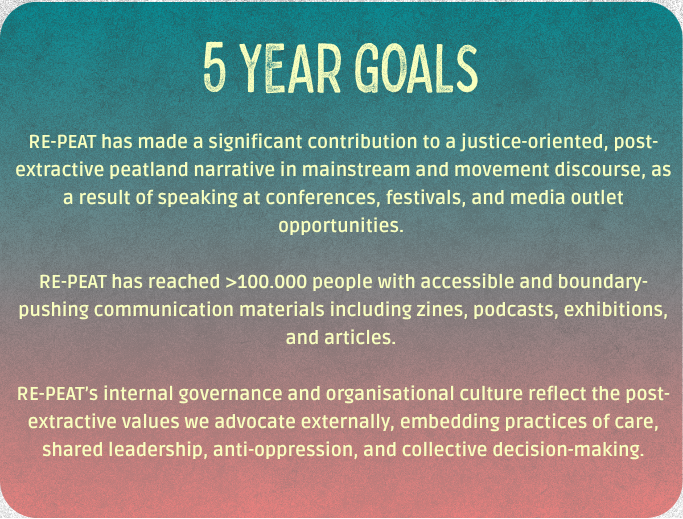
RE-PEAT cultivates the cultural and imaginative conditions for a world beyond extraction. Through peatlands, we explore and embody alternative ways of relating to land, economy, and one another. Peatlands become a starting point for questioning capitalist and patriarchal societies and developing post-extractive imaginaries rooted in care, interdependence, and humility.
Our artistic, cultural, and narrative work positions peatlands as teachers who invite us into slowness, deep listening, grief, experimentation, and collective dreaming. We create spaces where climate, ecology, economy, and social justice are understood as entangled, and where participants can explore what forms of life and organisation might emerge beyond extractivism.
Through exhibitions, podcasts, workshops, and cultural interventions, we develop and share frameworks that challenge dominant narratives and nurture alternative economic and political imaginaries. In doing so, we contribute to a broader cultural shift: from peatlands as wastelands to peatlands as living grounds for regeneration of society at large.
Projects: Grief workshops, Imagination workshops, Peatland exhibitions

Sign up to our newsletter!